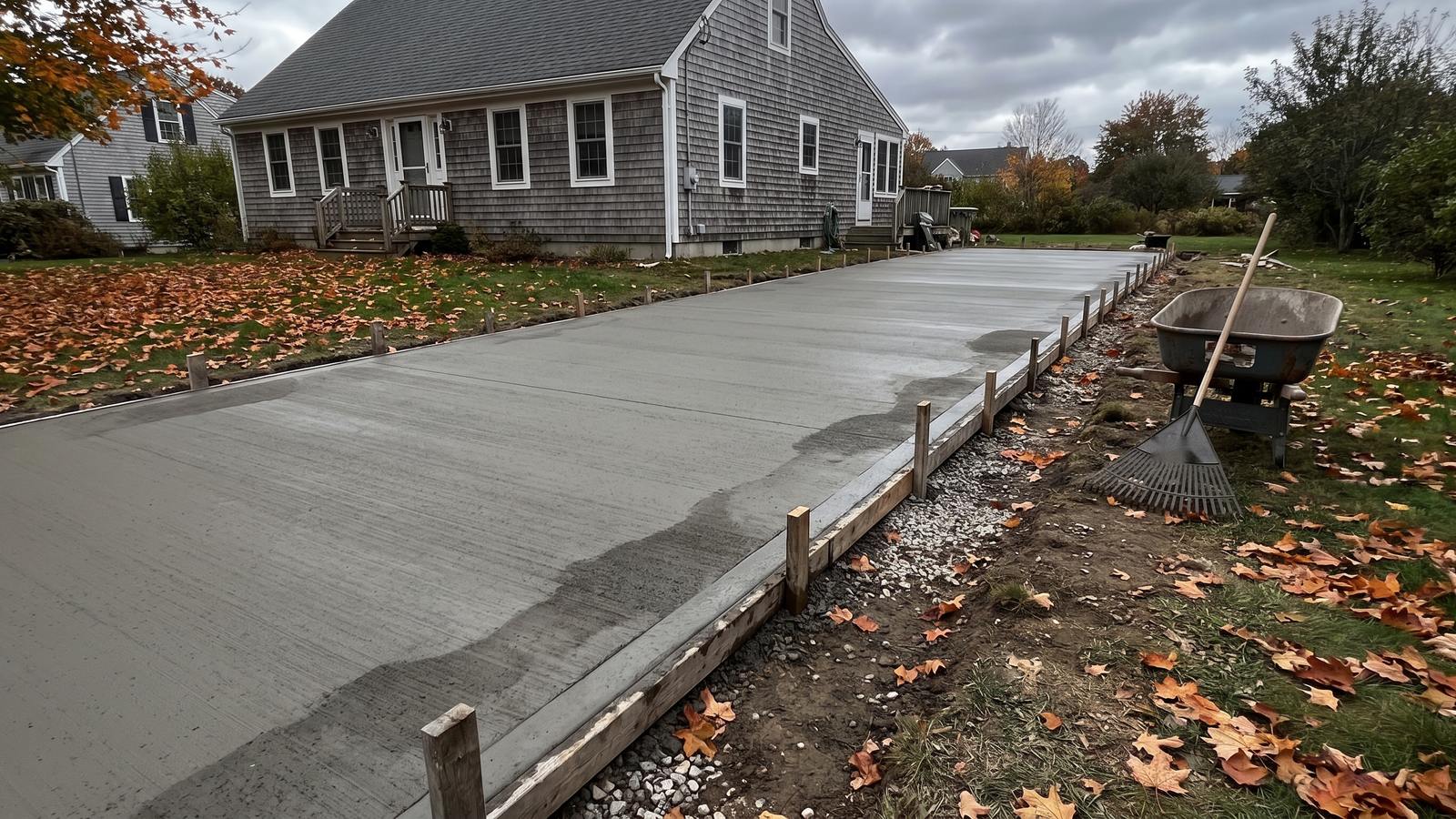
Concrete contractor in Portland, Maine
Driveways, patios, steps, slabs, foundations and repair for homes in Portland and nearby towns.
Residential concrete work in Portland, quoted in writing
We are a residential concrete contractor in Portland, Maine. We form, pour and finish driveways, patios, walkways and front steps, place garage and basement slabs, build footings and frost walls, and repair concrete that has cracked, flaked or settled.
A quote starts with a call or the form on this page. We ask what you want built or fixed, what is there now, roughly how big it is and how close a ready-mix truck can park. Photos and rough measurements help, but they are not required. Then we come out to measure, check which way water runs, look at the soil and note anything that has to come out first, from an old slab to a buried drain line.
The quote comes back in writing. It spells out the area and thickness, the gravel base, the concrete mix and its strength, the reinforcement, where the control joints go, the finish, who handles permits and the Dig Safe notice, and when the work could be scheduled. Written that way, two bids can be compared line by line instead of by the bottom number alone.
We keep to concrete. We do not pave asphalt, and we are not the City's contractor, so anything in the street or the public sidewalk, such as a new curb cut, needs City approval before work starts. If your job reaches that far, we tell you at the site visit.
We pour most outdoor work from spring into fall, but a winter call is still worth making: the quote, the permits and a date on the spring schedule can all be settled before the ground thaws.
Free quote
Get a free written quote
Concrete services for Portland homes
We take on six kinds of residential concrete work, and each rests on the same basics: a compacted gravel base, air-entrained concrete for anything outdoors, control joints placed before the slab can crack on its own, and a full cure. Each page below covers the choices and the Portland rules for that job.
Concrete driveways
New and replacement driveways, with the base, thickness, apron and curb cut planned together.
Learn morePatios and walkways
Broom-finished or stamped patios and front walks, pitched so water runs away from the house.
Learn moreConcrete steps
Front and back steps and stoops, on footings deep enough to keep frost from lifting them away from the door.
Learn moreSlabs and garage floors
Garage floors, basement floors and pads for sheds, generators and heat pumps.
Learn moreFoundations and frost walls
Footings, frost walls and foundation walls for additions, garages and new houses.
Learn moreConcrete repair
Cracked, flaking or sunken concrete, with a straight answer on repair versus replacement.
Learn moreConcrete costs in Portland
What moves the price of a concrete job here, and how to read a written quote.
Learn more
How a concrete job goes, from your call to cured concrete
A residential concrete job runs through seven steps, and the concrete itself only arrives at the sixth.
- Questions. By phone or through the form, we learn what you want, what is there now, the rough size and how a truck reaches the spot.
- A look at the site. We measure, check the grade and drainage, look at the soil and any old concrete, and find out whether the work reaches the street, a historic district or the shoreland zone.
- A written quote and contract. Maine's Home Construction Contracts Act requires a written contract signed by both sides for home construction work over $3,000 in materials or labor, lists what it must contain, and limits the first payment to one-third of the price (10 M.R.S. §1487). We write ours to that standard, with the Attorney General's consumer statement attached, and any change goes on a written change order signed by both of us.
- Dig Safe. Maine law requires notice to Dig Safe at least 3 business days, and no more than 30 calendar days, before machine digging starts, and utilities have 2 full business days to mark their lines. We pre-mark the dig area in white and make the call; the marking costs you nothing.
- Forms and base. We dig to the planned depth, take out soft soil, place and compact the gravel base, set the forms to the finished slope, and lay the rebar or wire mesh the quote calls for.
- Pour and finish. The concrete is placed, struck off and floated, and final finishing waits until the bleed water has left the surface, because finishing too early is a known cause of scaling. Then comes the broom finish or the texture you chose. Control joints are tooled in during finishing or saw-cut 4 to 12 hours afterward.
- Curing. New concrete is kept moist or sealed under curing compound, paper or plastic for at least 7 days, longer when temperatures sit near 40°F. Concrete left to dry out can lose as much as half its potential strength.
The price follows from those steps: the size and thickness, how much old concrete comes out, how much base the ground needs, how close the truck can get, the finish, and whether the pour needs cold-weather protection. Our page on what concrete work costs in Portland walks through each one.
What Portland's weather and ground ask of concrete
Freezing and thawing
At Portland International Jetport the low reaches 32°F or colder on 144.1 days in a normal year, yet the high stays at or below freezing on only 40.7 of them, and normal snowfall is 68.7 inches (NOAA, 1991-2020). Many winter days swing from below freezing to above it.
Concrete lasts through that when it is air-entrained, strong enough and well cured, so all three are written into every outdoor quote.
Deicers and salt
Deicers make freeze-thaw scaling worse, and some attack concrete outright: PCA says never to use deicers containing ammonium sulfate or ammonium nitrate, and NRMCA adds magnesium-based salts. For concrete that will see deicers, NRMCA recommends 4,000 psi with about 6% total air when the mix uses 3/4-inch or 1-inch stone.
Concrete poured late in the year should get no deicing chemicals its first winter. See deicers and new concrete for what to use instead.
Clay and ledge
Much of the region sits on the Presumpscot Formation, a marine silty clay named for the Presumpscot River valley in Portland and Westbrook. It holds a lot of water and drains slowly, and silty soils are the ones that heave when they freeze.
Under slabs and walks we dig out soft pockets and build a compacted gravel base that drains. Ledge, the Maine word for bedrock, is hard to predict without borings, so we look before we price a dig.
When concrete gets poured in Portland, and what a cold pour needs
We schedule most outdoor pours between spring and fall, because fresh concrete must not freeze before it gains strength. At Portland International Jetport the median last spring freeze is April 26 and the median first fall freeze is October 15.
Cold weather starts sooner than the first frost. The American Concrete Institute treats a pour as cold-weather work whenever the air temperature has fallen to, or is expected to fall below, 40°F during the protection period. Fresh concrete has to be kept from freezing until it reaches at least 500 psi, which NRMCA puts at about two days for most concrete kept at 50°F. Concrete that freezes before then can lose more than half its potential strength and will not be durable.
When a pour runs into cold weather, the plan changes. Snow, ice and frost come off the base and forms, and every surface the concrete will touch has to be above freezing, which can mean insulating or heating the ground first. NRMCA recommends that concrete for sections under 12 inches thick be at least 55°F when it is placed. Water curing is ruled out when freezing is near, so curing compound, paper or plastic takes its place, and accelerating admixtures speed the set but do not keep concrete from freezing.
New concrete should also be kept from freeze-thaw cycles until it reaches 3,500 psi. For a late-season job, the guide to pouring concrete in cold weather covers the protection step by step.
Portland rules that come up on concrete jobs
Most of Portland's rules for home concrete apply where your lot meets the street, so we check the curb cut, the apron and the sidewalk before anything is formed.
- Curb cuts. The traffic engineer and the public works authority approve the design and location of every curb cut, and none may be added or changed without their prior consent (City Code Sec. 25-101). On the Eastern Promenade between Atlantic and North streets, a driveway curb cut is capped at 13 feet (Sec. 25-110).
- Driveway size. For a home with nine or fewer parking spaces, the City's Technical Manual allows one driveway, 10 to 20 feet wide at the property line and at least 20 feet from any neighboring driveway.
- Aprons and sidewalks. An apron needs a permanent, erosion-resistant surface such as concrete, asphalt or brick, and new concrete that meets an existing concrete sidewalk must be doweled into it before the pour. Inside the historic districts the City's sidewalk policy calls for brick, and an apron crossing the sidewalk has to match.
- Historic districts. In a historic district such as Munjoy Hill, exterior alterations visible from a public way go through review, administrative or by the Historic Preservation Board depending on scope; ordinary maintenance is exempt.
- Street openings. Digging in a street or sidewalk takes a street opening permit and a City excavator's license. From November 15 to April 15 the City issues no street opening permits except in emergencies or special conditions (Sec. 25-133), and it may refuse them for five years after a street is built or rebuilt (Sec. 25-138).
- Building permits. City Code Sec. 6-92 requires a permit before a structure is built, altered or repaired, and the fee doubles when the permit comes after work has started, so we confirm with Permitting and Inspections whether your job needs one.
- Stormwater charge. The City bills a stormwater service charge in units of 1,200 square feet of impervious surface, rounded to the nearest unit (Sec. 24-84), and driveways, patios and walkways all count (Sec. 24-81).
- Shoreland zoning. Within 250 feet of a great pond, a river or the upland edge of a coastal or freshwater wetland (tidal areas included), or within 75 feet of a stream, non-vegetated surfaces such as driveways and patios are limited to 20% of the lot area inside the zone (70% in some General Development districts and in Commercial Fisheries/Maritime Activities districts), under Maine DEP's shoreland zoning rules.
- State routes. Portland is an urban compact municipality, so an entrance onto a state route inside the compact limits is permitted by the City rather than MaineDOT (23 M.R.S. §704).
Our guide to Portland's driveway and curb cut rules goes through the curb cut and apron steps in order.
Where we work in and around Portland
We work across Portland, on the peninsula and off it, take island jobs case by case, and cover six nearby towns that each have a page of their own.
In the city that includes Munjoy Hill, the West End, the East End, Deering Center, Back Cove, Rosemont, Stroudwater and North Deering. Portland's housing is old, with 45.8% of its homes built in 1939 or earlier, so on older lots we check what an existing slab or foundation is sitting on before we plan new work.
The islands take planning. Peaks Island's car ferry carries commercial vehicles by reservation, while the car ferry serving Great Diamond and Cliff Island has a 5,500-pound weight limit that rules out a mixer truck. We work out how concrete and equipment reach an island site before we quote.
Outside the city we work in South Portland, across the Fore River; in Westbrook, where the Presumpscot River runs through the center; and in Scarborough, Falmouth, Cape Elizabeth and Gorham. We also take jobs in Windham, Cumberland and Yarmouth. The towns with their own pages are linked below.

Snow on the ground? Plan the spring pour now.
Winter is a good time to settle the quote, the permits and a date, so the forms can go in once the ground allows. Call or send the form, and we will come measure when the site is clear.
Frequently asked questions
Do concrete contractors need a license in Maine?
No. Maine does not license general contractors, and the state's professional licensing office lists no license for concrete work or masonry; it licenses trades such as electricians and plumbers. The Attorney General advises researching any contractor well before you hire and asking for a lien waiver with each payment.
Does Maine require a written contract for concrete work?
It does for any contract over $3,000 in materials or labor to build, remodel or repair a home: Maine's Home Construction Contracts Act requires it in writing, signed by both sides, and caps the first payment at one-third of the price (10 M.R.S. §§1486-1487). We use a written contract on every job either way, and any change goes on a written change order that both of us sign.
What kind of concrete holds up to Maine winters?
Air-entrained concrete, which holds billions of microscopic air cells per cubic foot that give freezing water room to expand. For surfaces that will see deicers, NRMCA recommends 4,000 psi concrete with about 6% total air when the mix uses 3/4-inch or 1-inch stone. Finishing at the right time and at least 7 days of curing matter too.
Who calls Dig Safe before a concrete job in Maine?
The excavator, and Maine law counts whoever contracts for the dig as an excavator too, so the homeowner has a stake in it. Notice is required at least 3 business days and no more than 30 calendar days before digging with power tools or machines. We pre-mark the area in white and make the call ourselves, and utilities mark their lines at no cost.
Do you take concrete jobs on Peaks Island and the other islands?
Yes, case by case, because everything has to cross the water. The Peaks Island car ferry carries commercial vehicles by reservation, while the car ferry to Great Diamond and Cliff Island has a 5,500-pound weight limit that rules out a mixer truck. We work out how the concrete and equipment reach the site, by ferry or by barge, before we quote.
Do you pave asphalt driveways?
No. We work only in concrete: driveways, patios, walkways, steps, slabs, foundations and repair. If you are weighing concrete against asphalt for a driveway, we can quote the concrete version and explain what goes into it.
Planning a driveway, patio or steps in Portland?
Call or send the form, and we will set up a site visit and a written quote.
- Photos of the spot and of any old concrete that has to come out
- Rough measurements, even paced off
- Your timing: this season, next spring or just pricing
- Truck access: how close a ready-mix truck can park, and any gates or wires